

Jack Browne, Wichita Falls Times Record News edition, Sunday, February 14, 2026
Change never asks permission. It simply arrives, pulls up a chair, and starts rearranging the furniture.
Some people grumble. Some resist. But the ones who thrive — the ones who keep moving up and to the right — are the ones who learn to welcome the rearrangement. They understand that with change comes growth, and with growth comes opportunity.
We’re living in a moment when the future isn’t creeping toward us; it’s sprinting.
The doubling of recorded knowledge every twelve hours isn’t a statistic to admire. It’s a reminder that the world is accelerating whether we feel ready or not.
Expectations don’t slack off just because the pace is uncomfortable. Quotas don’t drop because the learning curve feels steep. Investor interest doesn’t pause to let us catch our breath. The question is always the same: What did you do for me today?
That pressure can feel relentless, but it also signals something important.
We are entering an era where curiosity is currency. The people who stay relevant are the ones who stay open — open to learning, open to experimenting, open to letting go of the way things used to be.
Nowhere is this more obvious than in the AI‑connected economy taking shape around us. Data center decisions — once the domain of back‑office engineers — now shape local economies, energy markets, and workforce development.
Communities that once debated where to put a new water tower are now debating where to put a hyperscale compute cluster. And just like every wave of innovation before it, this one brings out the familiar chorus of “Not In My Back Yard” concerns.
We’ve been here before. Water infrastructure. Power lines. Cell towers. Wind turbines. Every new technology that threatens the status quo triggers the same reflex: Why in my neighborhood? What about the noise? What about the view?
The details change, but the pattern doesn’t. Innovation arrives, resistance follows, and eventually the new thing becomes the normal thing.
AI is following that same arc. The largest semiconductor companies are now AI‑centric, and AI already accounts for half of the global semiconductor market revenue.
That’s not a forecast — it’s the present tense. Amazon, Anthropic, Google, Meta, Microsoft, OpenAI, Oracle, xAI, and a growing constellation of providers are weaving themselves into every industry, every workflow, every decision chain. AI is everywhere, not because it’s trendy, but because it’s useful. It’s the next general‑purpose technology, the kind that reshapes everything it touches.
Some people hear that and feel threatened. Others hear it and feel energized. I’ve lived long enough to know which group ends up happier.
The world is flattening again — not in the Thomas Friedman sense of globalization, but in the sense that access to intelligence, tools, and capability is becoming universal.
A kid in Wichita Falls can build something today that would have required a research lab 20 years ago. A retiree can launch a business from a kitchen table. A small nonprofit can analyze data like a Fortune 500 company.
AI doesn’t eliminate human potential; it amplifies it.
The real question is: Where will we be when the dust settles? Will we be the ones who dug in our heels, insisting the old ways were good enough? Or will we be the ones who leaned forward, embraced the future, and found joy in the learning?
Welcome the future. Let curiosity pull you forward. Let change stretch you. Let the next wave of innovation be something you ride, not something you brace against.
These decisions are in front of many communities — including Wichita Falls. I urge our City Council to embrace the AI opportunity. The increase in our tax base will improve the quality of life for every citizen.
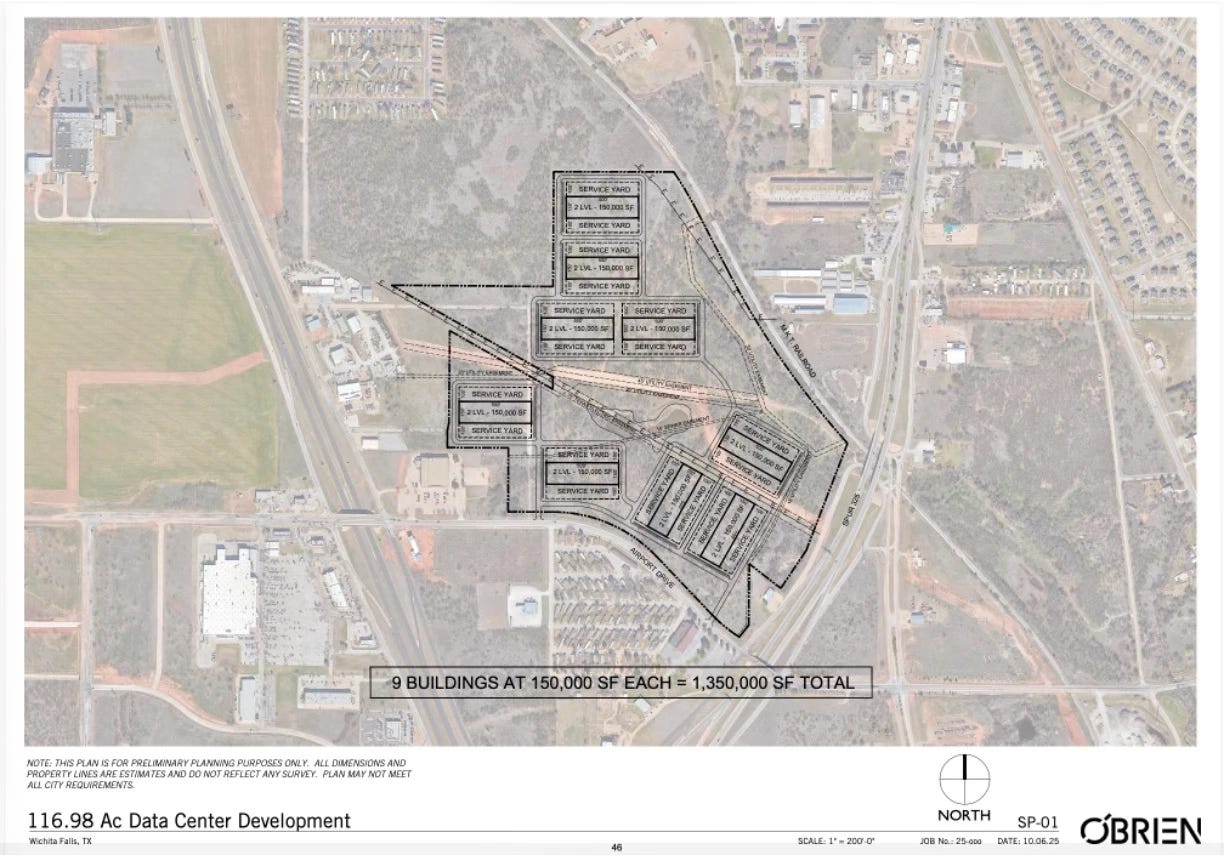
Industries deal with their challenges and risks to better optimize costs. Closed‑loop cooling significantly reduces water requirements, as the system is filled once, then maintains the environment for AI computing needs.
Electric demand stimulates new creativity. Small Modular Reactors are an emerging source, with Texas focusing on this new power option. Texas A&M‑RELLIS is hosting several SMR suppliers as they come to market. Other universities are also players in SMRs.
By the way, RELLIS stands for A&M’s core values of respect, excellence, leadership, loyalty, integrity and selfless service.
In any case, the Electric Reliability Council of Texas, is establishing protocols that allow rapid growth to be managed without undue burden on ratepayers while ensuring electricity continues to support the Texas miracle.
The future isn’t waiting for us to feel ready. It’s already here. And it’s offering us a chance — once again — to move up and to the right, increasing good for all in our life’s timeline.
Jack Browne is a community activist and former technology executive who believes in the power of connection and service.
P.S. The rest of the story,
Additional comments beyond what was included in Wichita Falls Times Record News article
While some may say we have about a dozen data center in planning so why do we need another. We don’t have any data centers currently under construction. A site decision with available land, electricity, high bandwidth network connectivity and water for start up requirements.
Timeline to construction has many more steps before a tenant, e.g. Microsoft, Google, OpenAI or another AI company commits to fund the facility. Till ground breaking this is just an opportunity and a place that could develop as a data center.
Electricity needs
ERCOT’s planning process is in redefinition due to number of large load connections soaring for 50 on planning backlog to over 250 data centers requests as of November 2025.1
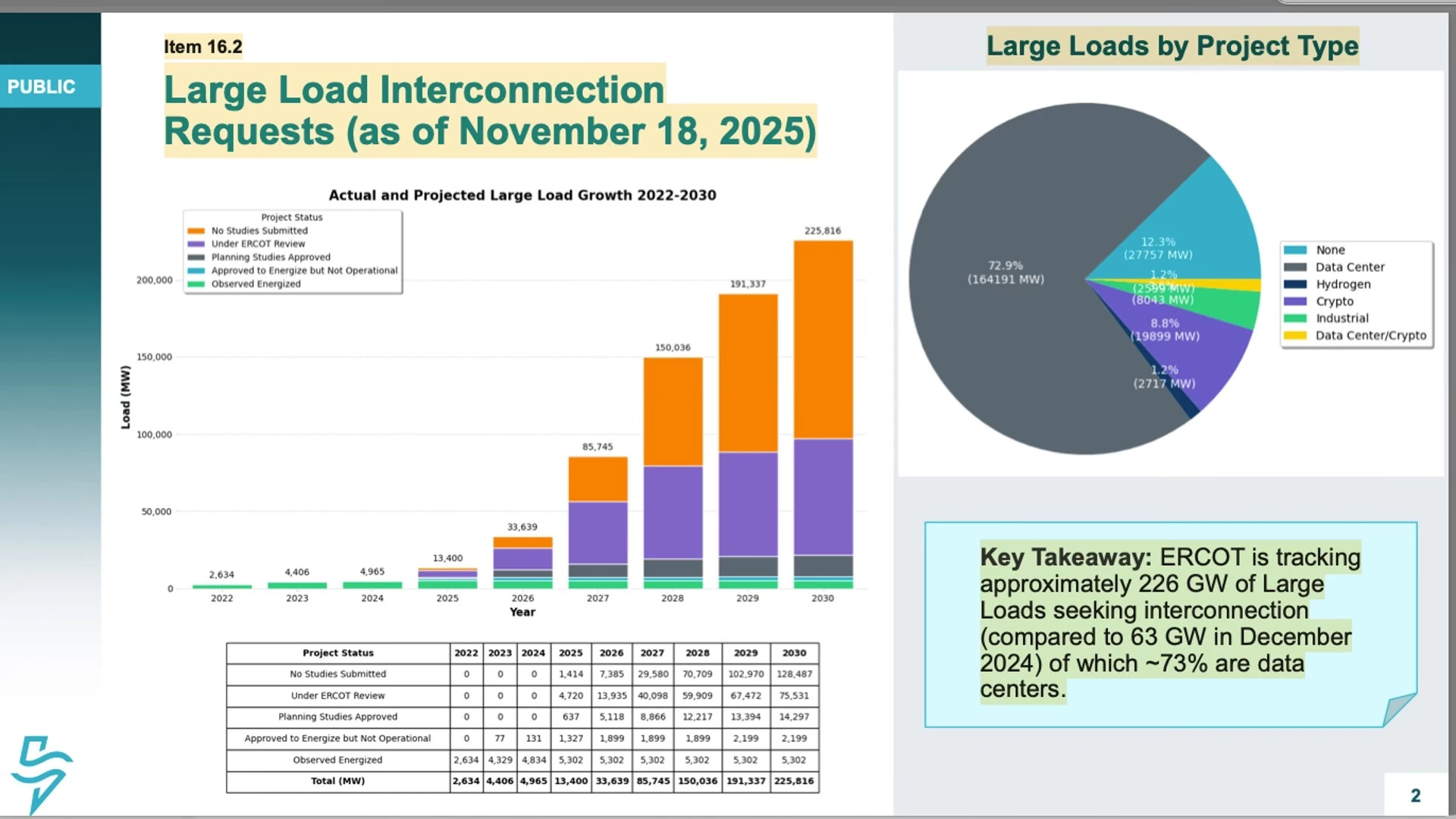
ERCOT Large Load Integration Program Optimization2
Additionally, ERCOT has contracted with McKinsey and Company to assist with improvement of the Large Load Interconnection process originally developed in 2022, which now has more than 225 gigawatts (GW) of Large Loads going through the process. ERCOT and McKinsey will work with Large Load customers, including data centers, utilities, and other stakeholders to develop a framework expected to identify short- and mid-term solutions to interconnection queue issues in early 2026 — with a goal of providing a streamlined, transparent, and consistent interconnection process for reliably connecting Large Loads later in the year.
“As we work to address current and future Large Loads connecting to the ERCOT grid, we want to provide the best solution to serve this growing area while also protecting the reliability of the grid,” said Woody Rickerson, ERCOT Sr. VP and COO. “McKinsey’s experience in complex program management will help facilitate this important work.”
Water needs
Data centers in planning will use closed loop water cooling. A 1-million-square-foot data center utilizing a true, non-evaporative closed-loop cooling system (such as air-cooled chillers or direct-to-chip liquid cooling) requires minimal water for operations compared to traditional evaporative systems. The water demand is concentrated during the initial setup, with negligible consumption thereafter.
Start-up (Initial Fill): Requires a one-time fill of the entire cooling infrastructure. For a facility of this scale, this can range from hundreds of thousands to over 1 million gallons to fill pipes, chillers, and heat exchangers.
Ongoing Operations: Near-zero, with water needed only for system “topping off” due to minor leaks or maintenance, or for non-cooling uses like humidification, bathrooms, and cleaning.
By the way 100 average homes in Wichita Falls would use approximately4.8 million gallons of water annually, based on data indicating that average Wichita Falls residents use approximately 48,000 gallons of water per year. This estimate is based on lower-than-average usage rates compared to other Texas cities, according to a2016 report from News Channel 6 | Wichita Falls, TX.
source: https://share.google/aimode/eOHvE2bCxmUeCZzsQ
ERCOT Announces Strategic Organizational Changes to Support Grid Reliability, Rapid Demand Growth, and Innovation, News Release Dec 12, 2025 https://www.ercot.com/news/release/12122025-ercot-announces-strategic