

Jack Browne, Wichita Falls Times Record News
Sunday, April 19, 2026
Two weeks ago, marked the 50-year anniversary of an understated but world changing moment: April 7, 1969, when the first Request for Comments, RFC 1, titled “Host Software,” was published.
That short technical document described how packets of data would move from one computer to another. From that simple idea came ARPANET — Advanced Research Projects Agency Network — and eventually the Internet.
What made the RFC process remarkable was not just the technology, but the philosophy.
The documents were open. Anyone could read them. Anyone could contribute. There was no paywall, no gatekeeper, no requirement to belong to a certain institution. That openness allowed a distributed network of researchers, engineers, and operators to rapidly improve and expand the system together.
More than 8,500 RFCs later, the Internet has grown into the global platform that powers our economy and daily lives.
Work, commerce, communication, learning, and entertainment now ride on infrastructure most of us never think about. We carry supercomputers in our pockets and expect instant access to nearly everything.
Back in 1970, Wichita Falls had a population of 96,265, making it roughly the 10th to 12th largest city in Texas at the time. Today, with about 102,400 residents, the city ranks around 42nd. For decades, many communities like ours watched growth and investment gravitate elsewhere.
That chapter is closing.
By 2030, Wichita Falls will look very different as large-scale internet infrastructure arrives in force.
Planned data centers and a 5,500-acre solar farm project from TotalEnergies Renewables USA in Wichita County are no longer abstract ideas. They are real, permitted, and underway.
The solar project alone will deploy roughly 1.56 million panels with an estimated investment of $830 million. County commissioners recently approved a $1.25 million annual payment in lieu of taxes agreement tied to that development.
On the data center side, the scale is significant. Construction on the first of several projects, the Skybox Power Campus, is expected to begin this year. During peak construction, between 3,500 and 5,000 workers could be on site, building up to ten 150,000 square foot facilities. Over time, the campus could reach three to four million square feet, with initial operations beginning around 2028.
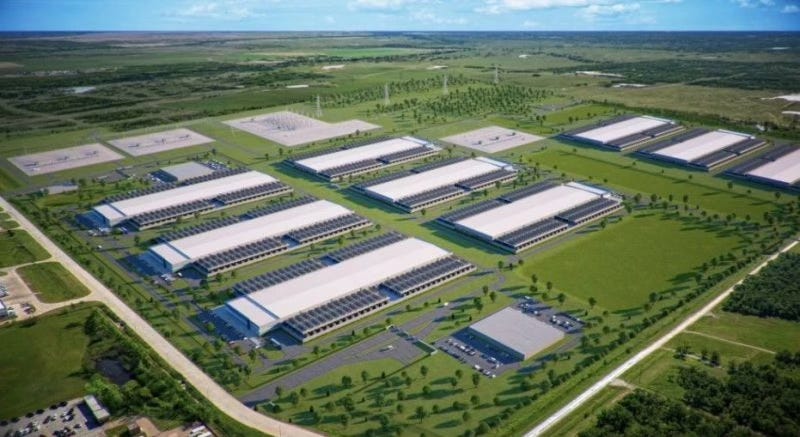
Additional projects are moving forward across the region.
Kings Ranch Data plans two data centers on 33 acres near Riley Road on the city’s northeast side.
A separate 300-megawatt data center with on-site battery storage and solar received rezoning approval in November off Kiel Lane and City View Drive, potentially hosting up to 2.3 million square feet of space.
Just last week, a Planned Unit Development for another data center project north of Airport Drive received Planning and Zoning approval. That site includes nine two story buildings, each 150,000 square feet, and could employ anywhere from 1,000 to 6,000 workers during construction.
This activity is not isolated.
Nearby Wilbarger County already has dirt work underway for a Google data center that will draw power from the TotalEnergies solar farm.
Archer and Young counties are also in discussions related to similar projects and the temporary workforces that accompany them.
With scale comes concern.
At recent Planning and Zoning meetings, city leaders discussed draft ordinances to guide temporary housing for construction workers. The goal is to meet short-term demand while ensuring land is restored when the need passes.
City staff have visited Abilene and other communities to learn both best practices and unintended consequences. The intent is to preserve what residents value while accommodating growth.
Public comments also raised questions about water and electricity.
Developers responded with details that rarely make headlines. Modern data centers use closed-loop cooling systems that require a one-time water charge of roughly 500,000 gallons. That is about the equivalent of ten average Wichita Falls homes using 4,000 gallons per month. Ongoing water use is minimal.
On the power side, Wichita Falls benefits from robust transmission infrastructure built over decades, originally to serve the Oklaunion coal plant and later expanded to integrate wind generation into the Electric Reliability Council of Texas, or ERCOT grid.
ERCOT actively manages large loads and can throttle usage during peak demand to maintain reliability. These facilities are designed to be flexible partners to the grid, not threats to it.
Housing pressure is likely. Based on experiences in Abilene, rents will rise during peak construction periods. That is precisely why proactive planning for temporary housing matters.
The opportunity is substantial. Wichita Falls currently has a tax base of around $8 billion. The Skybox project alone projects up to $12 billion in investment over time. As multiple data center developments come online, the expanded tax base creates alternatives. Roads, utilities, and infrastructure improvements can be funded without increasing taxes on current residents.
Change is uncomfortable. Some people would prefer none at all.
But history shows that communities which opt out of technological shifts tend to stagnate while others move ahead.
These data centers are not just buildings. They are the backbone of artificial intelligence driven services that support everything from healthcare and manufacturing to logistics, education, and national security.
Hosting them positions Wichita Falls as a 21st century contributor to a strong and growing U.S. economy.
The same spirit that made the Internet possible — open participation, shared benefit, and long-term thinking — is now shaping our future.
Recognizing that moment and preparing our workforce, infrastructure, and community to meet it strengthens us while offers opportunities for our citizens.
Jack Browne is a community activist and former technology executive who believes in the power of connection, service, and lifelong learning.